Whether a garage slab is dry decides more about an epoxy garage flooring job than the size of the garage does. Concrete poured without a vapor barrier underneath pulls moisture up from the ground, and a coating laid over a slab doing that will lift within a season or two. Moisture gets established before a system is specified, not after.
Plenty of garage slabs in this part of New Hampshire went down before a plastic vapor barrier under concrete was routine. Some sit on wet sand. Some sit on ledge that sheds groundwater sideways. None of that rules a floor out for epoxy garage flooring. It changes which primer goes down first, and it changes the number on the estimate.
What Epoxy Garage Flooring Does That Bare Concrete Cannot
Bare concrete in an unheated garage does three things you notice, and one you do not. It dusts, so everything on a low shelf wears a gray film. It drinks, so one drip of gear oil leaves a permanent dark shape. It holds salt, so brine off a truck sits in the pores through March and works on the slab from the inside.
Epoxy garage flooring closes those pores. Snowmelt pools on top instead, and a squeegee pushes it out the door. Sand and grit sweep off rather than grinding in. You can also see the floor, which matters more than it sounds when the garage doubles as the place you split kindling and park the mower.
Professional Epoxy Flooring Services in Bradford NH
Attached garages, detached garages, barn bays and shop floors all take a coating. Most epoxy garage flooring work around Bradford involves a one or two-car detached building with no heat and a single circuit run out from the house. That is worth planning around rather than being surprised by.
Two things are worth sorting out before install day. Power comes first, because floor grinding equipment wants more than a fifteen-amp outlet at the end of an extension cord will give. Access comes second. If the drive goes soft in April, or the turnaround is tight, say so on the phone rather than on the morning.
Our shop is at 8 Industrial Way in Salem, NH, so a job in Bradford means a real drive for the crew. Mention anything about the site that would be hard to discover from a photograph.
Our Epoxy Garage Flooring Process
Prep decides the outcome. Acid etching washes concrete with acid, roughens the top skin unevenly, and leaves residue behind wherever it is not neutralized properly. Mechanical grinding cuts that skin off instead. It opens the pores to the same depth everywhere, corners included, and the strip along the wall where an etch always goes light. Grinding also lifts old paint, old sealer and whatever glaze a power trowel left behind. Nothing else does as much to decide whether epoxy garage flooring stays bonded in ten years.
Filling comes before coating. Static cracks take a semi-rigid filler, ground flush. Control joints work differently. Those tooled straight lines were cut deliberately so the slab would crack out of sight, and they keep moving afterward. One option fills them and coats straight over for a single clean surface, accepting that a hairline may show later. The other honors the joint, leaving a visible line that never surprises you. It is worth deciding at the estimate.
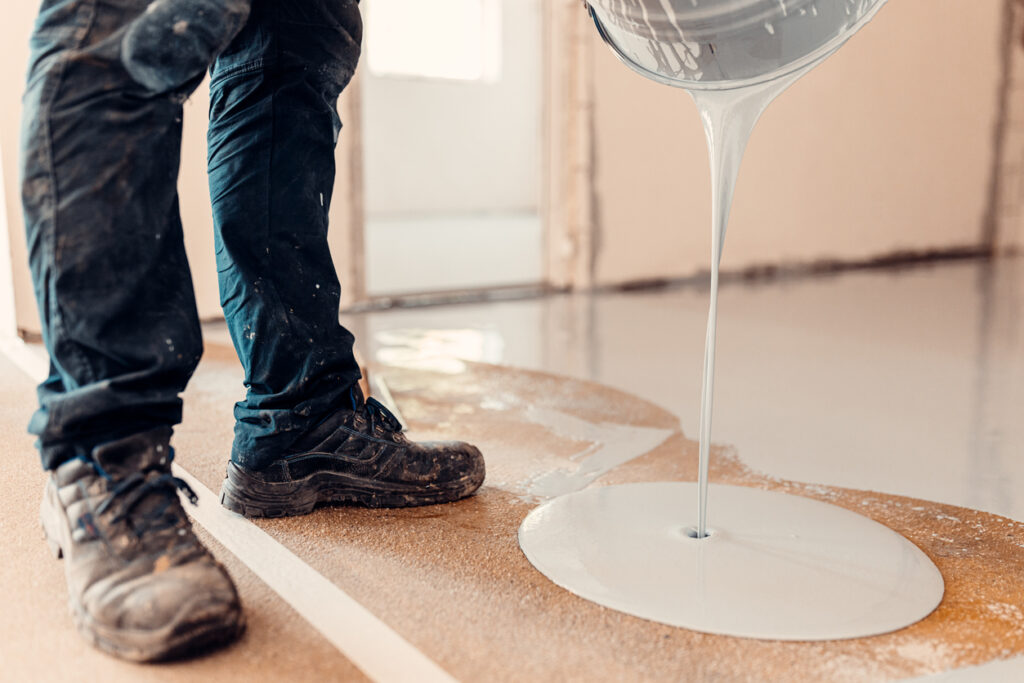
Primer, base, topcoat. The moisture result picks the primer. Then a colored base coat. Then flake broadcast to refusal if you want flake. Then a clear topcoat, which takes all the wear.
The calendar belongs in the spec. Epoxy cures through a chemical reaction, and cold concrete slows that reaction down. Below a certain surface temperature standard epoxy stops curing properly, and it can stay soft or bloom. An unheated garage in this part of New Hampshire lags the air temperature by weeks in both directions. The slab still runs cold in early May when the days feel warm, and it still holds summer heat in October. Epoxy garage flooring in an unheated building is a scheduling question as much as a product question.
The Benefits of Hiring a Professional Epoxy Flooring Contractor
Compare a box-store epoxy garage flooring kit honestly. It gives you an acid pouch where the job wants a grinder, and one can of thinned water-based product claiming five hundred square feet of coverage. Spread that across a two-car garage and you can nearly see through the film. Kits fail at prep and they fail at thickness. Both failures look identical from the doorway. Fine for a year, then letting go in patches.
Then count what a failure costs. Stripping a coating that has partly released means grinding the whole floor again, through the old material, which runs slower than grinding bare concrete did. Cheap floors are rarely cheap twice. Hiring a contractor buys the machine, enough material on the truck to lay the film at spec in one pass, and somebody who has to come back.
Custom Epoxy Flooring Options
Epoxy garage flooring comes in a few finishes, and they suit different rooms.
Flake. Vinyl chips broadcast into a wet base coat, then sealed under clear. Flake hides dust and the odd tire mark, and it gives enough texture underfoot that a wet boot stays put. Most working garages end up here.
Solid color. The cleanest look and the brightest room, and the least forgiving of anything left on it. Good where the garage holds a car and a bench. Less good where it also holds a snowblower.
Metallic. Pigment worked while wet so the color moves and pools. It photographs beautifully. Treat it as a finish rather than a work surface.
Slip resistance. Any of the three can take an aggregate in the clear coat. It is worth doing if the floor pitches toward the door and collects a sheet of meltwater under the truck every time you park wet. Ask at the estimate so it goes into the topcoat.
Serving Homeowners and Businesses in Bradford NH
Three buildings come up most often around Bradford. A detached two-car garage added after the house, usually on an older slab with no vapor barrier under it. A newer attached garage tucked under a bedroom, where cure time and odor matter most. A pole barn or shop bay where somebody parks a tractor, welds occasionally, and wants a floor they can sweep.
All three take epoxy garage flooring, and all three take a different spec. Shop bays want a heavier build and a filler in the topcoat. Pole barn slabs want the moisture question answered before anything else, because those went down straight onto sand more often than not. Attached garages want the low-odor route and a straight answer about which days the cars sleep outside.
The Cost of Epoxy Garage Flooring
Four things move the price of epoxy garage flooring, and only one of them is the size of the garage.
What the slab needs first. Clean, dry, sound concrete grinds and coats. A failed sealer, an old paint job, a moisture problem or spalling by the door all add work before the coating stage, and that work costs labor.
How much crack and joint repair is needed. Ten feet of hairline barely registers. A settled corner starts a different conversation, and sometimes the honest answer is that a coating spends your money in the wrong place.
Which system goes down. A single-coat product and a full primer, base, flake and topcoat build make two different floors. They should not carry one price.
Square footage. Last, because a small garage on bad concrete regularly costs more than a big garage on good concrete.
The number for your epoxy garage flooring comes after somebody has looked at the floor, rather than over the phone.
Epoxy Garage Flooring Questions from Bradford NH Homeowners
My garage is detached and has no heat. Can it be coated in winter, or do I wait for spring?
The slab temperature decides that, not the date. Standard epoxy wants concrete above a minimum surface temperature to cure properly, and an unheated slab runs colder than the air around it. It also lags the air by weeks, so a warm week in March does very little for the floor. The realistic options are to heat and dehumidify the building through install and full cure, which adds cost and setup days, or to take a spring date. Describe the building and you can get a straight answer about which one fits.
How does anyone know the slab will hold a coating before work starts?
By testing it for moisture, which is the first question rather than an afterthought. A slab that transmits moisture from the ground will push a coating off, and that is common in older garages poured without a vapor barrier. It rarely kills a job outright, because moisture-tolerant primers exist and will hold on damp concrete. It does change the primer and it changes the price. Knowing beforehand is the whole point of asking.
There is no outlet in the garage and the nearest one is at the house. Is that a problem?
Not if it is raised early. Grinding takes real power, more than an extension cord run from the house will carry, so the power source has to be worked out before install day rather than on it. Water is not needed, because the grinding is done dry into a vacuum. The one thing that genuinely stops the work is no way to get a vehicle within reach of the door, so mention it if the drive goes soft in mud season.
A previous owner painted the floor gray. Does all of that have to come off?
Yes, and grinding handles it. Floor paint sits on top of concrete rather than keying into it, so anything laid over it holds only as well as that paint holds, which is usually not well. The grinder lifts the paint and opens the concrete in one pass, ready for epoxy garage flooring. It is not an extra step, just a slower one. Old sealers, tile adhesive and driveway coatings all get the same treatment. Raise it at the estimate, because it changes how long the prep day runs.
I plow with the truck, so sand and salt brine cover that floor from December to April. Will a coating survive?
Salt gives cured epoxy garage flooring very little trouble, and abrasion causes more. Sand tracked in under a tire works like sandpaper, so the clear topcoat is what does the protecting. That layer is sacrificial and eventually gets recoated. Two habits help. Keep a squeegee by the door so brine leaves instead of drying in place, and rinse when the weather breaks. Do not spread de-icer directly on the floor, and do not leave an open bag of it standing on the surface.
The floor has straight cut lines running across it. Are those cracks?
No. Those are control joints, cut deliberately when the slab was finished so that shrinkage cracking happens inside a straight line instead of wandering across the floor. They still move seasonally. There are two ways to handle them. Fill and coat over them for one clean surface, accepting that a hairline may show in a year or two, or honor the joint and leave a visible line that never surprises you. Random cracks that wander are a different repair.
Talk to an Epoxy Garage Flooring Contractor About Your Bradford NH Garage
Send the garage dimensions, the year the slab went in if you know it, and one photo taken from the doorway with the light on. That is enough to say what would need testing, and roughly when in the year the epoxy garage flooring would want to go down. Call (603) 865-1444 or use the form below.